
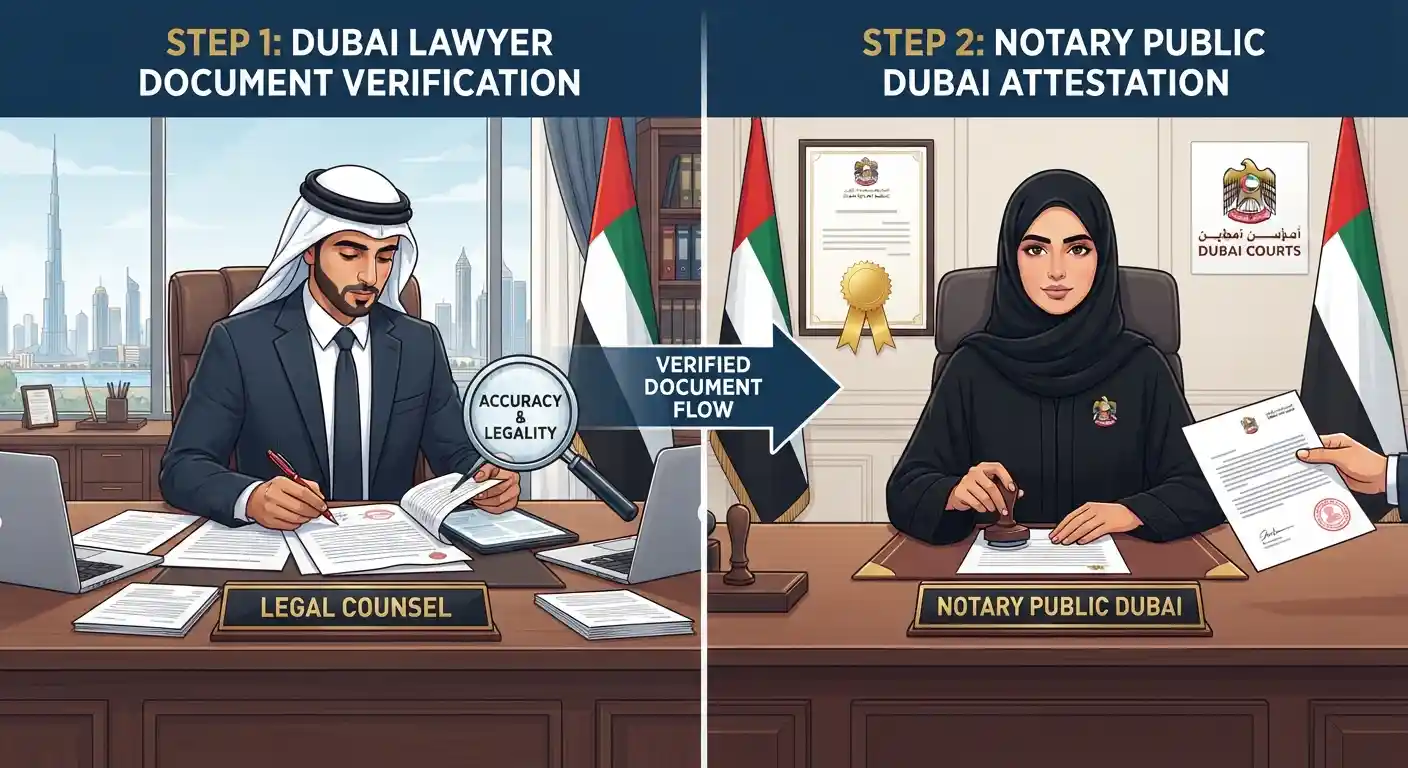
Yes, Dubai Lawyers can assist individuals and businesses in reviewing and verifying the accuracy of documents before submitting them to a Notary Public Dubai for notarization. Document verification is an important part of the notarial process because errors, missing information, inconsistent details, or incorrect wording can result in delays or rejection.
Notarized documents are frequently used in commercial transactions, financial arrangements, personal declarations, corporate matters, and legal proceedings. Therefore, ensuring that a document is properly prepared before notarization can help individuals avoid unnecessary complications.
A Notary Public Dubai performs official functions within the scope of the applicable UAE legislation. These functions may include verifying the identity and capacity of the parties, confirming their consent, administering oaths where required, and authenticating eligible legal instruments.
Dubai Lawyers can complement this process by examining the document’s legal wording, identifying potential inconsistencies, and advising clients about the requirements applicable to their particular circumstances.
1. Why Is Document Verification Important Before Notarization?
Document verification helps ensure that the information contained in a legal instrument is accurate, complete, and consistent with the supporting records.
Even minor mistakes can create difficulties during notarization. For example, incorrect identification details, inconsistent company names, missing signatures, or unclear contractual provisions may require the document to be corrected before the notarial process can continue.
Dubai Lawyers can review documents before submission and identify issues that may affect their acceptance.
Document verification is particularly important for:
- Affidavits and sworn statements.
- Powers of attorney.
- Commercial agreements.
- Corporate resolutions.
- Debt acknowledgements.
- Financial declarations.
- Legal undertakings.
- Documents intended for international use.
The review process helps ensure that applicants understand what they are signing and that the document reflects their actual intentions.
2. What Details Should Be Checked Before Visiting a Notary Public Dubai?
Several important details should be reviewed before submitting a document for notarization.
Personal information: The names, passport numbers, Emirates ID details, and other identification information should correspond with the official records.
Company information: Corporate documents should contain the correct legal name, registration details, and relevant information about authorised representatives.
Contractual provisions: Agreements should clearly explain the obligations and responsibilities of the parties involved.
Dates and financial figures: Any payment amounts, deadlines, transaction dates, and other numerical information should be carefully checked.
Signatures and authorisations: The document should comply with the applicable signing and authorisation requirements.
Language requirements: Applicants should confirm whether the document must be prepared in Arabic or accompanied by an acceptable legal translation.
Checking these details before submission can reduce the possibility of delays during notarization.
3. Can Dubai Lawyers Review Affidavits Before Notarization?
Yes. Lawyers can review affidavits and sworn statements to ensure that their wording accurately communicates the facts being declared.
An affidavit may contain information concerning personal circumstances, financial obligations, commercial transactions, or disputes. Its wording should be clear and should not include unsupported allegations or misleading information.
For example, an individual preparing an affidavit concerning an unpaid financial obligation may need to explain when the agreement was entered into, how much money was transferred, and what amount remains outstanding.
Dubai Lawyers can examine the available documents and help prepare a declaration that accurately reflects the relevant circumstances.
Once the affidavit is ready, it can be submitted to a Notary Public Dubai for the appropriate oath and notarization procedure.
4. Can Document Verification Help in Debt Recovery Cases?
Yes. Document verification can be particularly useful in debt recovery matters because financial disputes often involve multiple documents and transactions.
A creditor may have an agreement, invoices, bank statements, payment reminders, and correspondence with the debtor. If these documents contain inconsistent information, establishing the outstanding amount may become more complicated.
Dubai Lawyers can review the available records and identify discrepancies before the creditor proceeds with formal recovery action.
For example, a company may claim that another business owes AED 150,000 under a commercial agreement. However, the debtor may have already made partial payments that are not properly reflected in the creditor’s account statement.
Reviewing the relevant financial records helps establish the correct outstanding balance and reduces the risk of presenting inaccurate information.
In Debt collection Dubai matters, accurate documentation can help support payment demands, settlement negotiations, and applicable court proceedings.
5. What Documents Are Commonly Reviewed Before Notarization?
The documents required depend on the nature of the transaction and the purpose of notarization.
Common examples include:
- Valid passports and Emirates IDs.
- Commercial agreements and contracts.
- Company incorporation documents.
- Trade licences.
- Shareholder resolutions.
- Financial statements.
- Bank transaction records.
- Invoices and payment receipts.
- Previous legal notices.
- Supporting affidavits and declarations.
If a company representative is signing on behalf of an organisation, additional evidence of authority may be necessary.
The notary may also request further documents depending on the type of instrument and the applicable legal requirements.
6. Can Incorrect Information Lead to Rejection by a Notary?
Yes. A notary may decline to process a document if it contains errors, fails to satisfy the applicable formalities, or raises concerns about the identity, capacity, or consent of the parties.
For example, an affidavit containing incorrect personal details may need to be corrected before it can be notarized.
Similarly, a corporate document may require additional authorisation if the person presenting it does not have the necessary authority to act for the company.
Legal professionals can help identify such issues before the application is submitted. However, the final decision concerning acceptance and notarization rests with the competent notarial authority.
7. Can Dubai Lawyers Assist With Documents Intended for Use Outside the UAE?
Yes. Dubai Lawyers can help individuals and companies understand the requirements for preparing documents in Dubai that will subsequently be submitted to foreign authorities.
International documents may require additional authentication, legalisation, or certified translation depending on the destination country.
For example, a Dubai-based business may need to provide a notarized corporate declaration to an overseas financial institution. The institution may require the document to undergo additional attestation before accepting it.
Before arranging notarization, applicants should confirm the requirements of the receiving authority to avoid unnecessary expenses and delays.
8. What Is the Difference Between Legal Document Review and Notarization?
Legal document review and notarization are separate procedures.
Legal document review involves examining the contents of an instrument to identify drafting errors, unclear provisions, missing information, and potential legal issues.
Notarization is an official function performed by an authorised notary public in accordance with the applicable legislation.
For instance, a lawyer may review a sworn statement and recommend changes to its wording. The notary subsequently performs the relevant official formalities, including administering the oath where required.
Neither process should be confused with a guarantee that every factual statement in the document is true or that the document will automatically succeed in court proceedings.
9. How Can Applicants Prepare for a Smooth Notarization Process?
Applicants can take several practical steps to make the notarization process more efficient.
First, they should identify the exact purpose of the document and confirm the requirements of the authority receiving it.
Second, all supporting documents should be organised before submitting the application.
Third, personal and corporate information should be checked carefully.
Fourth, any required translation should be completed through an appropriately qualified service provider.
Finally, applicants should confirm whether the relevant notarial service requires physical attendance or allows electronic processing.
Preparing these details in advance can help minimize avoidable delays.
Conclusion
Document verification is an important step before notarization because it helps ensure that legal instruments are accurate, complete, and suitable for their intended purpose. Dubai Lawyers can assist by reviewing affidavits, agreements, corporate documents, financial declarations, and other instruments before they are presented to a Notary Public Dubai.
Their assistance can be particularly valuable in commercial and financial matters where documentary accuracy plays an important role. In Debt collection Dubai cases, reviewing agreements, invoices, payment records, and sworn statements can help creditors organise their evidence and identify inconsistencies before pursuing recovery action.
Although legal review can reduce drafting and documentation errors, the notary remains responsible for performing the official notarial functions within their legal authority. Applicants should therefore ensure that their documents satisfy both the relevant legal requirements and the specific conditions imposed by the receiving authority.