
Introduction
Choosing the right maintenance provider is an important decision for any business or property owner. Equipment and building systems require regular professional attention to remain reliable, and the quality of maintenance can directly affect performance, operating costs, and downtime.
An Annual Maintenance Contract (AMC) can provide a structured way to manage these requirements. However, not every maintenance provider offers the same level of service. Differences in technical expertise, contract coverage, response times, pricing, and customer support can significantly affect the overall value of an agreement.
Selecting a provider based only on the lowest price can sometimes result in limited service coverage or unexpected costs. Businesses should instead evaluate several factors before signing a long-term maintenance agreement.
Understand Your Maintenance Requirements First
Before contacting maintenance companies, businesses should understand what they actually need.
This includes identifying the equipment, systems, and facilities that require regular maintenance. Businesses should also consider how frequently the equipment is used and how important it is to daily operations.
For example, a commercial property may require maintenance for air conditioning, electrical systems, plumbing, generators, fire safety equipment, and other building facilities.

Having a clear understanding of these requirements makes it easier to explain expectations to potential maintenance providers.
Evaluate the Provider’s Experience
Experience is one of the most important factors when choosing an AMC provider.
A maintenance company with relevant industry experience is more likely to understand common equipment problems, maintenance procedures, and technical requirements.
Businesses should consider how long the provider has been operating and whether it has experience working with similar properties or equipment.
Relevant experience can be particularly important when maintaining complex or specialized systems.
Check Technical Expertise
A maintenance provider should have technicians with appropriate technical knowledge and practical experience.
Different equipment requires different maintenance procedures. A provider may be experienced in general facility maintenance but may not have the expertise required for specialized machinery or technical systems.
Businesses should therefore ask whether the provider has qualified technicians capable of handling the specific systems covered under the AMC.
Review the Services Included
The scope of services is one of the most important parts of an annual maintenance contract.
Businesses should request a detailed explanation of what is included in the agreement.
Services may include scheduled inspections, preventive maintenance, cleaning, testing, troubleshooting, minor repairs, and emergency support.
The agreement should clearly identify the equipment covered and the maintenance activities that will be performed.
Avoid making assumptions about coverage. If a service is important to the business, it should be clearly mentioned in the contract.
Ask About Maintenance Frequency
Different equipment may require different maintenance schedules.
Some systems may need monthly inspections, while others may require quarterly or biannual servicing.
A reliable provider should be able to recommend an appropriate maintenance frequency based on equipment usage, manufacturer guidance, operating conditions, and system requirements.
Businesses should ensure that the proposed schedule is clearly included in the agreement.
Consider Response Times
Response time becomes especially important when an unexpected equipment problem occurs.
A business should understand how quickly the maintenance provider can respond to service requests.
Some AMC agreements specify response times for standard issues and emergency situations.
Businesses that rely on critical equipment should pay particular attention to these terms because delayed service can result in extended downtime.
Check Emergency Support
Not every maintenance issue occurs during normal business hours.
An equipment failure may happen at night, during a weekend, or on a public holiday. Depending on the nature of the business, waiting until normal working hours may not be practical.
Businesses should determine whether the AMC includes emergency maintenance support and whether additional charges apply to after-hours service.
Understanding this before signing the contract can prevent confusion when an urgent problem occurs.
Compare Pricing Carefully
Price is an important consideration, but it should not be the only factor.
Two providers may offer different prices because their contracts include different levels of service.
One agreement may include regular inspections and emergency support, while another may provide only basic preventive maintenance.
Businesses should compare the total value of each contract rather than simply choosing the lowest quotation.
Understand Additional Charges
An AMC may not cover every possible maintenance expense.
Some providers charge separately for spare parts, major repairs, replacement components, or services outside the agreed scope.
Businesses should ask the provider to clearly explain all possible additional charges.
This information makes it easier to estimate the actual cost of maintaining the equipment throughout the contract period.
Review Contract Exclusions
Exclusions are just as important as included services.
Businesses should carefully review what the provider will not cover.
Common exclusions may include major replacement parts, equipment damaged through misuse, modifications, or repairs caused by factors outside normal operation.
Understanding exclusions helps businesses avoid unexpected expenses and make better comparisons between providers.
Check Customer Reviews and Reputation
A provider’s reputation can provide useful information about service quality.
Businesses can review customer feedback, testimonials, case studies, or references when available.
While online reviews should not be the only basis for a decision, consistent feedback about response times, technical expertise, communication, and reliability can help identify potential strengths or weaknesses.
Businesses can also ask prospective providers for references from customers with similar maintenance requirements.
Evaluate Communication and Customer Service
Good technical service is important, but communication also matters.
A maintenance provider should be easy to contact and willing to explain maintenance issues clearly.
Businesses should consider how the company handles service requests, communicates technician arrival times, provides reports, and responds to customer questions.
Clear communication can make the overall maintenance relationship more efficient.
Check Service Documentation
Professional maintenance providers should maintain appropriate records of inspections and service work.
These records may include the date of each visit, equipment inspected, work completed, faults identified, components replaced, and recommendations.
Businesses should ask whether maintenance reports will be provided after scheduled visits.
Proper documentation can help businesses track equipment condition and plan future maintenance activities.
Ask About Qualified Technicians
The quality of maintenance depends heavily on the technicians performing the work.
Businesses should determine whether technicians are trained and experienced with the equipment included in the contract.
For specialized systems, relevant technical certifications or manufacturer training may also be important.
Choosing a provider with capable technicians can reduce the risk of improper maintenance and recurring equipment problems.
Check Availability and Service Coverage
Businesses should make sure that the provider can support their location and operational requirements.
If a company operates multiple properties, it may need a maintenance provider capable of servicing all relevant locations.
Service availability should be discussed before signing the agreement.
Businesses should also understand whether the provider has sufficient technical staff to handle multiple service requests during busy periods.
Read the Contract Before Signing
Never sign an AMC without reviewing the agreement carefully.
Important details include the contract duration, service frequency, equipment covered, payment terms, response times, emergency support, exclusions, additional charges, cancellation conditions, and renewal process.
If any part of the agreement is unclear, businesses should ask the provider for clarification before signing.
A clear contract protects both the customer and the service provider.
Compare Multiple Providers
Businesses should ideally obtain quotations from several maintenance companies.
Comparing different providers can reveal differences in service coverage, pricing, response times, technical expertise, and contract flexibility.
The goal should not be to find the cheapest provider but to identify the company that offers the most suitable combination of quality, reliability, coverage, and cost.
Think About Long-Term Value
An annual maintenance contract should be viewed as a long-term maintenance investment rather than simply another operating expense.
A reliable provider can help businesses reduce unexpected breakdowns, maintain equipment performance, and manage maintenance more efficiently.
The value of the agreement should therefore be evaluated over the entire contract period.
A provider that offers consistent service and proactive maintenance may deliver greater long-term value than a cheaper company with limited support.
Final Thoughts
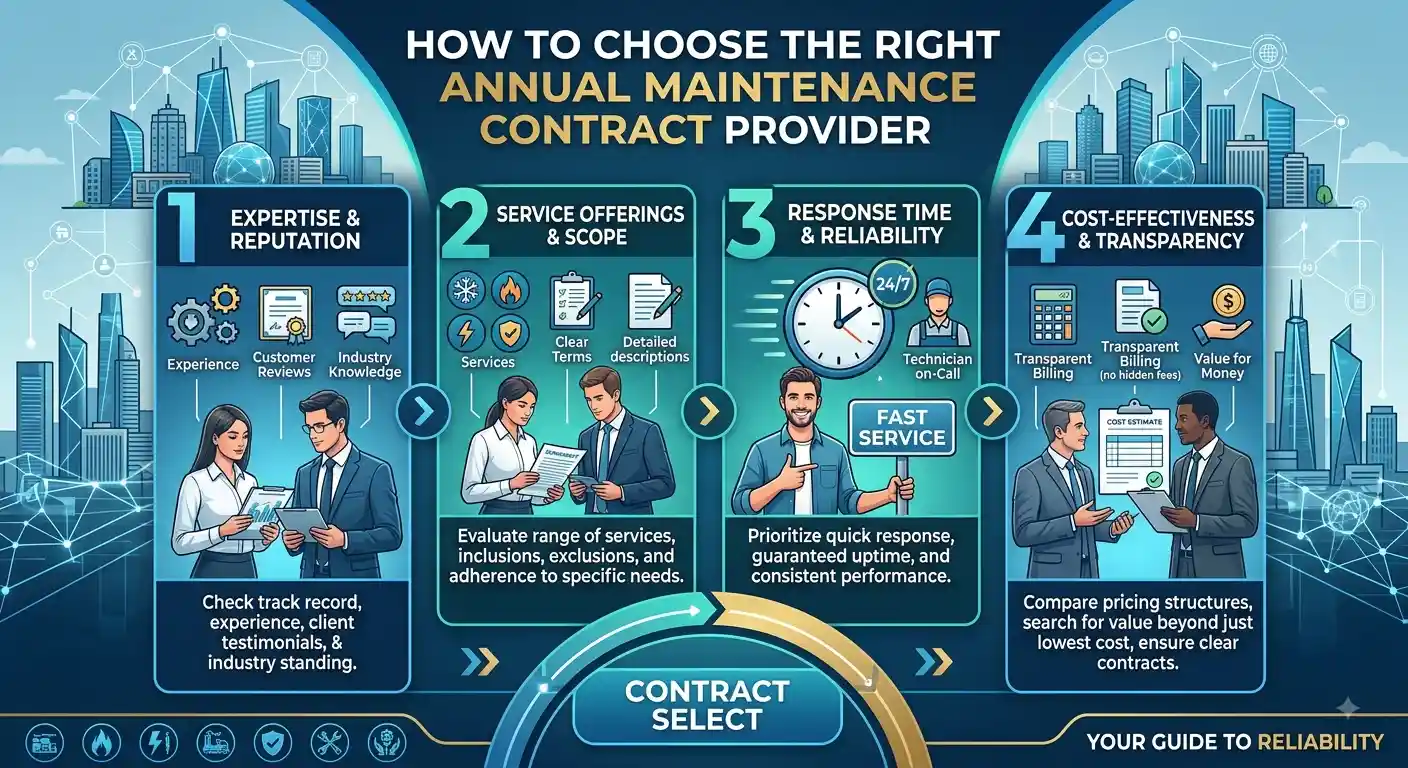
Choosing the right Annual Maintenance Contract provider requires careful evaluation. Businesses should consider technical expertise, experience, service coverage, maintenance frequency, response times, emergency support, pricing, exclusions, and customer service before making a decision.
A well-written contract should clearly explain what is included and what may result in additional charges.
Rather than focusing only on price, businesses should choose a provider that understands their equipment and can deliver reliable maintenance throughout the contract period.
With the right maintenance partner, an annual maintenance contract can help protect valuable assets, reduce unexpected disruptions, and support efficient long-term business operations.
Related Reading: AC Repair and Maintenance For Offices and Homes
Related Reading: Which SS Pipe is ideal for Plumbing or Construction? — full guide
Related Reading: كيف تطوّر موقعك وتمنحه حياة حقيقية على الإنترنت — full guide
Related Reading: Deck & Fence Staining in London, ON — full guide
Related Reading: Top 5 Football Shoes in the UAE to Own the Pitch — full guide