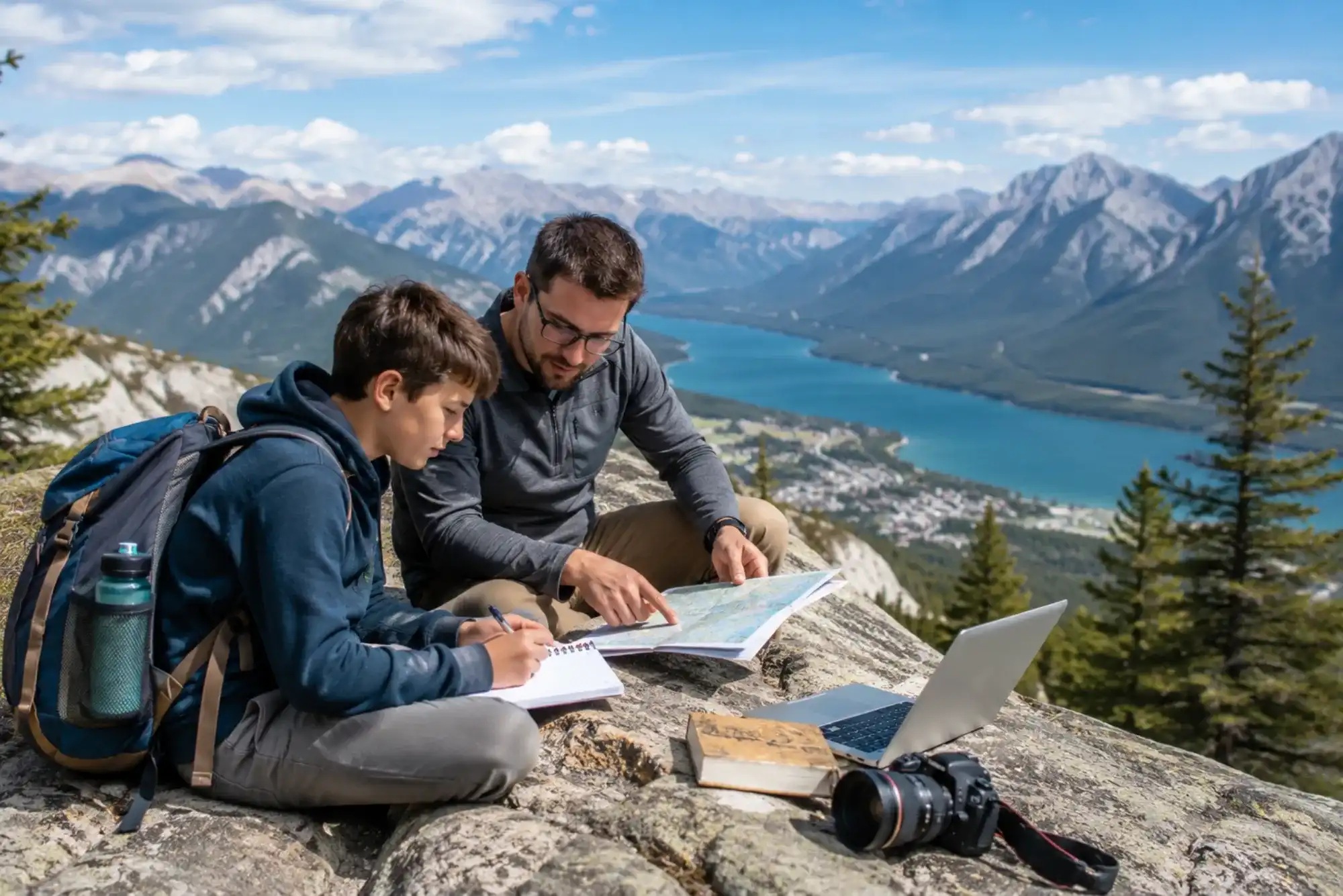
The tension is real and most families feel it within the first few weeks of serious travel with children: you’re standing at the edge of a volcanic crater in Iceland, or watching a dhow glide across Dubai Creek at sunset, and somewhere in the back of your mind is the nagging question of whether your twelve-year-old is falling behind in algebra. The whole point of travel-based education is that the world itself becomes the classroom — but the world doesn’t structure itself into convenient forty-five-minute lessons, and the moments worth pausing for don’t always align with the curriculum. Getting this balance right is the central challenge of the lifestyle, and it’s where the quality of a skilled travel tutor makes the most significant difference.
Why the Tension Exists in the First Place
Adventure and formal academics pull in genuinely different directions. Adventure is unscheduled, responsive, and sensory — it rewards presence and spontaneity. Formal academic work is structured, sequential, and abstract — it requires sustained focus, clear sequencing, and consistent follow-through over time. A child who is fully present at an extraordinary experience isn’t simultaneously doing productive mathematics practice, and a child deep in a complex reading passage isn’t really available for the unexpected discovery around the next corner.
The error that derails many families is trying to pretend this tension doesn’t exist — either by loading up the travel schedule with so many “educational” activities that they stop being genuine experiences and become another form of classroom, or by letting adventure run completely unchecked until weeks pass without any meaningful academic continuity and the catching-up task becomes daunting. Both failure modes are common. Both are avoidable.
The starting point is accepting that balance doesn’t mean equal time for both every day. It means that over a week, a month, a term — the child has made genuine progress on formal academic objectives AND has had genuinely enriching experiences that no classroom could replicate. These don’t have to happen simultaneously; they have to happen consistently.
The Weekly Architecture: Separating Focused Work from Open Exploration
The most consistently effective structure that experienced travel-educating families converge on is a simple weekly architecture that separates different types of engagement rather than trying to blend them into every moment.

Three to four mornings per week are designated as focused academic time — typically the hours between eight and noon, when children are most cognitively fresh and before the day’s adventure begins. These sessions are structured, consistent in format, and protected from interruption. The tutor runs them with genuine rigour: lesson sequences that build on each other, assignments that get completed and assessed, skills that get practised until they’re solid. This is where the formal curriculum happens.
The remaining time — afternoons, full adventure days, travel days — is genuinely free from academic obligation. No worksheets hiding in the backpack, no guilt about not “fitting in some maths.” The experience is the experience. If a child is exploring a souk, climbing a cliff face, or learning to cook a regional dish, they’re doing exactly what they should be doing. The tutor’s job in these moments is not to intervene but to listen — gathering the material that will anchor the next formal session.
This separation does something important psychologically for children: it clarifies expectations. When it’s work time, they know what’s expected and can commit to it without distraction. When it’s exploration time, they can be fully present without the background anxiety of unfinished academic obligations. Children operating in ambiguous environments — where every experience might become a “lesson” — often become resistant to both learning and experiencing.
The Integration Point: Using Experience as Academic Raw Material
The real artistry of good travel tutoring isn’t in the formal sessions — it’s in what happens at the seam between experience and formal learning. The best practitioners are constantly gathering material from the adventure side that becomes the anchor for academic work.
A day spent snorkelling on a reef doesn’t replace a biology lesson — but it provides the concrete observation base that makes a biology lesson on marine ecosystems genuinely meaningful rather than abstract. The child who watched a parrotfish biting coral is far more motivated to understand the nitrogen cycle than one who has only read about it. The tutor’s job is to identify those connections and use them deliberately: “Remember what you noticed about the colour change on those sea anemones? Let’s look at what’s actually happening chemically when that occurs.”
This is the mechanism by which travel-based education at its best produces students who understand subjects rather than merely knowing facts about them. The experience provides the emotional hook and the concrete referent; the academic work provides the framework that transforms experience into understanding. Neither works as well without the other. A child who experiences everything but understands nothing is a tourist. A child who understands frameworks but has experienced nothing is an abstract thinker disconnected from the world. The travel tutor’s job is to build the bridge between the two.
Age-Appropriate Balance: It Looks Different at Every Stage
The right balance between adventure and academics shifts significantly as children develop, and families who try to apply the same model across all age groups typically find it doesn’t work well for at least some of their children.
Ages 6–10: Experience Heavy, Structure Light
Younger children are in a developmental stage where direct experience is the primary mode of learning — they absorb knowledge through doing, observing, and playing in ways that are genuinely different from how they’ll learn as teenagers. Formal academic sessions for this age group can be shorter (sixty to ninety minutes is often sufficient), less abstract, and more directly connected to what they’re experiencing. Reading, writing, and number sense are the real priorities; the rest of the curriculum can be largely delivered through well-designed experiences. The adventure-to-academics ratio here should probably be around four to one.
Ages 11–14: Building Rigour Without Losing Wonder
The middle years are where getting the balance wrong has the most significant long-term consequences. Children in this range are developing abstract thinking capacities and genuinely benefit from the academic rigour that travel-based education can provide — but they’re also at the peak of their experiential receptiveness. The worst outcome is losing one without gaining the other: grinding through formal academics at the expense of genuine experience, or letting experience crowd out the structured practice that builds real competence. This age group benefits most from a skilled tutor who can manage both dimensions simultaneously — maintaining genuine academic expectations while keeping the connection to experience alive.
Ages 15–18: Academic Priority with Strategic Adventure
Older students preparing for examinations — IGCSEs, IBs, A-levels, SATs — need a structure that prioritises academic outcomes without abandoning the experiential dimension entirely. The adventure side of the equation becomes more strategic at this stage: experiences are chosen for their direct relevance to examination subjects where possible, and the ratio shifts toward more formal academic work. A student studying history for an examination who spends time in a region directly relevant to their curriculum is having an experience that serves both purposes simultaneously.
The Tutor’s Role in Protecting Both Sides of the Equation
One of the less-discussed functions of a good travel tutor is advocacy — not just for academic rigour, but for genuine adventure. In families where parents are anxious about academic progress, there can be a drift toward filling every possible moment with structured learning, gradually squeezing out the open exploration time that makes travel-based education worth doing. A skilled tutor pushes back on this.
Equally, tutors sometimes need to hold the academic line in families where the adventure pull is very strong and everyone — parents included — would happily skip the morning study session for one more day at the beach. The professional relationship creates a productive accountability that family dynamics alone don’t always provide. Parents find it easier to maintain a structure when they’re not solely responsible for enforcing it, and children often engage more readily with a tutor than with a parent-as-teacher.
This dual advocacy function — protecting both the academic rigour and the adventure time — is one of the clearest markers of a tutor who understands what travel-based education is actually for, rather than one who is simply delivering conventional tutoring in an unconventional location. The specialist networks connecting families with genuinely qualified travel tutor tend to emphasise this philosophical alignment as a hiring criterion, recognising that technical subject knowledge alone doesn’t make someone effective in this role.
Planning Destinations Around Learning Objectives
Families who approach destination planning thoughtfully — choosing where to spend extended time with an eye on what academic material those destinations can support — find the balance problem considerably more tractable. Destination planning for educational purposes isn’t about visiting “educational” places (museums, historical sites) rather than experiential ones — it’s about understanding what each destination offers and building the curriculum to use it.
A family with a child studying ecology who spends six weeks in Costa Rica has a living laboratory for that subject that no classroom can match. A family with a child working on ancient history who bases themselves near Rome or Athens has field access to primary sources that textbooks can only approximate. This isn’t about restricting travel to “worthy” destinations — almost anywhere in the world offers rich material for almost any subject if the educational design is thoughtful enough. It’s about making the planning conversation happen deliberately rather than treating destination and curriculum as separate decisions.
The UAE itself offers remarkable material for this kind of integrated learning. The intersection of ancient trade routes and ultra-modern urban development, the cultural diversity concentrated in a small geography, the contrast between desert ecology and engineered coastlines — these are genuinely rich educational resources for students in almost any subject area. Families based here before setting out on extended travel often find that the city itself provides excellent preparation for the kind of comparative thinking that travel-based education fosters. Exploring what Dubai’s best activities have to offer reveals just how much educational depth is accessible even within a single city when approached with genuine curiosity.
Managing the Re-Entry Question
One of the most persistent anxieties for families considering travel-based education is whether their child will be able to return to conventional schooling — whether at university, at a new school in a new country, or simply at the end of a sabbatical year. The concern is legitimate but often overestimated.
The re-entry question is primarily a documentation question. Students who can demonstrate their learning through well-maintained portfolios, performance on standardised assessments, and articulate self-reflection about what they’ve studied tend to be evaluated fairly by receiving institutions. Students who arrive with an undocumented year and a collection of photographs have a harder time. The difference is almost entirely in how carefully the tutor and family maintained records throughout the period.
Universities and schools in the UK, US, and Australia — which collectively accept the largest numbers of international students — have become significantly more comfortable with non-traditional educational pathways over the past decade. Gap year programmes, international schooling, and homeschooling all have established review frameworks at most selective institutions. Travel-based education, properly documented, fits within those frameworks more readily than many families initially assume.
What helps most is establishing the documentation standard from the very first week of mobile education, not retrofitting it at the end. A simple weekly learning log — what was covered, what was accomplished, what needs further work — takes twenty minutes to write and creates an invaluable record over months of travel. Combined with completed assignments, project portfolios, and periodic standardised assessments, this documentation tells a coherent story of a student who has been genuinely learning throughout.
When the Balance Tips Too Far
Every family doing this seriously goes through periods where the balance breaks down in one direction or the other. Adventure runs away with the schedule for three weeks and the formal curriculum falls completely behind. Or the family hits a difficult patch — illness, logistical chaos, a bad destination choice — and academic work becomes a lifeline of normalcy while genuine exploration dries up. Neither of these is a failure; both are normal parts of a genuinely dynamic educational model.
The recovery from an adventure-heavy imbalance looks like a deliberate recalibration: acknowledging honestly where academic continuity has been lost, prioritising the subjects with the highest stakes or the most sequential dependency (mathematics and foreign languages lose ground fastest when neglected), and returning to a structured schedule without dramatising the gap. Children are remarkably resilient learners when motivation is high, and the experiential richness of travel-based education tends to keep motivation high even when the formal work is temporarily demanding.
The recovery from an academics-heavy imbalance — where the family has been grinding through curriculum without genuine exploration — is simply permission. Permission to skip the morning session for an extraordinary experience. Permission to follow a child’s genuine interest somewhere unexpected. Permission to let a week be led by curiosity rather than curriculum, trusting that the investment in rich experience will pay dividends in later academic engagement. This is harder for anxious parents than it sounds, but it’s consistently what experienced travel educators recommend.
The Social Dimension: Adventure Requires Other Children
A dimension of the balance question that formal curriculum discussions often understate is the social one. Children need other children — not as a luxury but as a developmental necessity. Academic work can happen one-to-one between tutor and student; the social and emotional growth that comes from navigating peer relationships, managing conflict, building friendships across difference — these require actual other children, and they happen in the adventure space rather than the academic space.
Worldschooling communities — both online and the co-ops that form in specific destinations — have emerged partly to address this gap. Families spending extended time in popular worldschooling hubs (Chiang Mai, Lisbon, Tbilisi, and increasingly parts of the UAE) find these communities quickly. The social connections that form tend to be unusually deep, partly because the children have so much more in common with each other (the experience of mobile education, the cultural fluency, the self-direction) than with their home-country peers. Kids clubs at beach clubs, activities in family-friendly communities, and organised group experiences can all supplement these connections — the range of kids’ activities across Palm Jumeirah illustrates the kind of structured social engagement available even within a single neighbourhood when families are looking for it.
The Sustainability Question: How Long Can This Last?
Families often start travel-based education with a fixed horizon — a year, maybe two — and then discover partway through that the model is working better than expected and they want to continue. Or they discover that it’s working less well than expected and need to recognise that honestly. The sustainability of the adventure-academics balance over longer time frames depends on a few factors that become clearer in practice than in planning.
Children’s tolerance for mobility varies enormously and can change as they age. A child who thrived on constant novelty at ten may deeply want consistency and peer community at fourteen. The educational model needs to evolve with the child, not remain fixed in the structure that worked at the beginning. Checking in honestly with children about what’s working and what isn’t — and giving their input genuine weight in decisions — tends to extend the viable period of travel-based education considerably.
Tutor continuity matters more over longer time frames than families often anticipate. A good working relationship between a student and their tutor builds genuine momentum — the tutor understands the student’s learning patterns, the student trusts the tutor’s judgment, and the academic work happens with a naturalness that takes months to develop. Frequent tutor changes disrupt this and are one of the more common causes of families feeling that the model isn’t working as well as it should. Prioritising continuity — through remote work when the tutor can’t be physically present, through careful transition planning when changes are unavoidable — is worth significant effort.
What Balance Actually Feels Like When It’s Working
Families who have found the balance — really found it, not just temporarily achieved it — describe something that doesn’t quite sound like either “school” or “holiday.” It’s more like a life where learning is woven into experience rather than separated from it, where curiosity is the primary driver of each day, and where both the formal academic work and the genuine adventures feel purposeful rather than obligatory.
Children in this situation tend to be unusually articulate about their own learning — they know what they’ve been working on, they can explain why it matters, and they have genuine opinions about what they want to explore next. That self-direction, combined with real academic progress and rich experiential depth, is probably the most compelling case for the model — not as a superior alternative to conventional schooling for everyone, but as a genuinely excellent option for families who can make it work.
For families in the UAE exploring travel opportunities that can serve both adventure and educational purposes, the range of options within the region is genuinely rich. From desert ecology to maritime history to contemporary urban design, the Gulf provides extraordinary raw material for travel-based learning before families even consider international destinations. For a sense of what’s available, the travel and activity resources across the UAE offer a starting point for families building itineraries that serve both the adventure and academic sides of the equation simultaneously.
Conclusion: The Balance Is Built, Not Found
Families who are still searching for the right balance between adventure and academics typically haven’t yet built the systems and philosophical clarity that make it sustainable. The balance doesn’t arrive naturally — it’s constructed deliberately, through clear structures, honest conversations with children about expectations, and a tutor who genuinely understands both sides of what travel-based education is trying to achieve.
The travel tutor’s role in this is not to impose a school structure on the road, nor to let everything float free in the name of experiential learning. It’s to hold both commitments simultaneously — the commitment to genuine academic progress and the commitment to genuine adventure — and to build the bridge between them week by week, destination by destination, lesson by lesson. When that works well, the result is something that conventional education rarely manages: a child who is developing real knowledge and real wisdom at the same time, and who is doing it in a world that has become, in the fullest sense, their classroom.
Frequently Asked Questions
How many hours of formal study per day is appropriate for travel-based education?
Should every travel experience be turned into a lesson?
What happens to the academic balance during intense travel days (long flights, moving between countries)?
How do you handle a child who consistently resists the academic sessions when adventure is available?
Related Reading: FPV Terminal Autonomy: Why Operator Control Plus Target Lock is a Game Changer
Related Reading: Maldives Tour Package from Dubai – A Perfect Tropical Escape for UAE Travelers — full guide
Related Reading: Top 5 Football Shoes in the UAE to Own the Pitch — full guide
Related Reading: Initio Side Effect: A Bold and Unforgettable Fragrance Experience — full guide
Related Reading: Book Cheap Flight Ticket: Smart Ways to Save on Airfare